
For Bianca Johnson, Learning Starts With Being Seen
When Bianca Johnson walks into a classroom, she tends to notice the quiet child.
“I was the quiet kid,” she said. “I was the kid who pretty much got overlooked. Awkward, tall for my age. I was reserved in public.”
All she wanted was for an adult to notice her in the corner, make eye contact, get down on her level and say hello.
“I always wanted a me,” she said, meaning the adult she has become.
Today, as Frazer Center’s new Infant & Toddler Curriculum Coordinator, Bianca tries to be that person. She seeks out the quieter children. She gets on their level. And she talks to them.
“Even with the infants. I just talk to them,” she said. “I think it’s important. It matters.”
A classroom education that started early
Bianca has worked in education for about 20 years, but she began studying teachers long before her first job.
Her maternal grandmother taught at the school Bianca attended as a child. Bianca was in a gifted and talented program that sometimes allowed her to leave her own classroom, and she would head to her grandmother’s room.
“I took all of it in,” she said.
Classroom materials her grandmother no longer needed came home with Bianca, where her brother and teddy bears became her students.
Years later, Bianca returned to the same school as a substitute teacher while she was in college. She spent three years in public education before moving into preschool.
“I fell in love, and I’ve been in preschool ever since.”
Her work soon began extending beyond the classroom. In 2011, she self-published Clap to Beauty: A Toddler Self-Esteem Book, which helps young children name their body parts, their differences, and what makes each of them unique.
In 2016, she founded Youth Love Self LLC, an enrichment program focused in part on helping preschoolers develop expressive language. She remembers teaching two-year-olds to say, “I need my space,” giving them words to use when they were frustrated rather than pushing another child away.
More recently, Bianca became a Registered Behavior Technician. She is now pursuing a master’s degree in Applied Behavior Analysis at Western Governors University and expects to complete the program in April 2027.
Her experience got the attention of Susie Riddick during the hiring process, but Susie remembers something else from the interview.
“She came across as very open-minded, communicative, and seemed like she would be a very good fit for our team,” Susie said. “And she has shown herself to be just that.”
Finding a place for both sides of her work
Bianca first encountered Frazer while searching online for curriculum specialist positions. She found a video about the Center’s history and began learning more.
She thought about families she had known who struggled to find early education programs that could serve their children. She had seen children turned away from other programs.
At Frazer, she saw a chance to bring together her experience in early childhood education and her work supporting children with differing needs.
“That’s what I love about Frazer Center,” she said. “I get to practice in both fields at the same time.”
The campus caught her attention, too. Coming from a city environment, Bianca was surprised to find Frazer tucked into a forest in the middle of Atlanta. Now that setting is becoming part of the way she works with teachers.
Frazer uses the L.E.A.P. Curriculum from The Learning Experience as a foundation for classroom learning. Bianca encourages teachers to take the lessons further.
If a lesson focuses on the color blue and the weather, for example, she might suggest taking the children outside to gather twigs, then using those twigs to paint with blue paint.
With process art, she encourages teachers to slow down. Children can put their hands in the paint, spend time with different textures and explore without being hurried toward a finished product.
“Art shouldn’t be rushed anyway,” she said.
Knowing what comes next
For Bianca, learning in an infant or toddler classroom depends in part on predictability.
“Toddlers [need to be] able to feel stable in their environment. Trust their environment,” she said. “It’s not chaos. After this, we do this.”
Susie has already seen Bianca put that idea into practice.
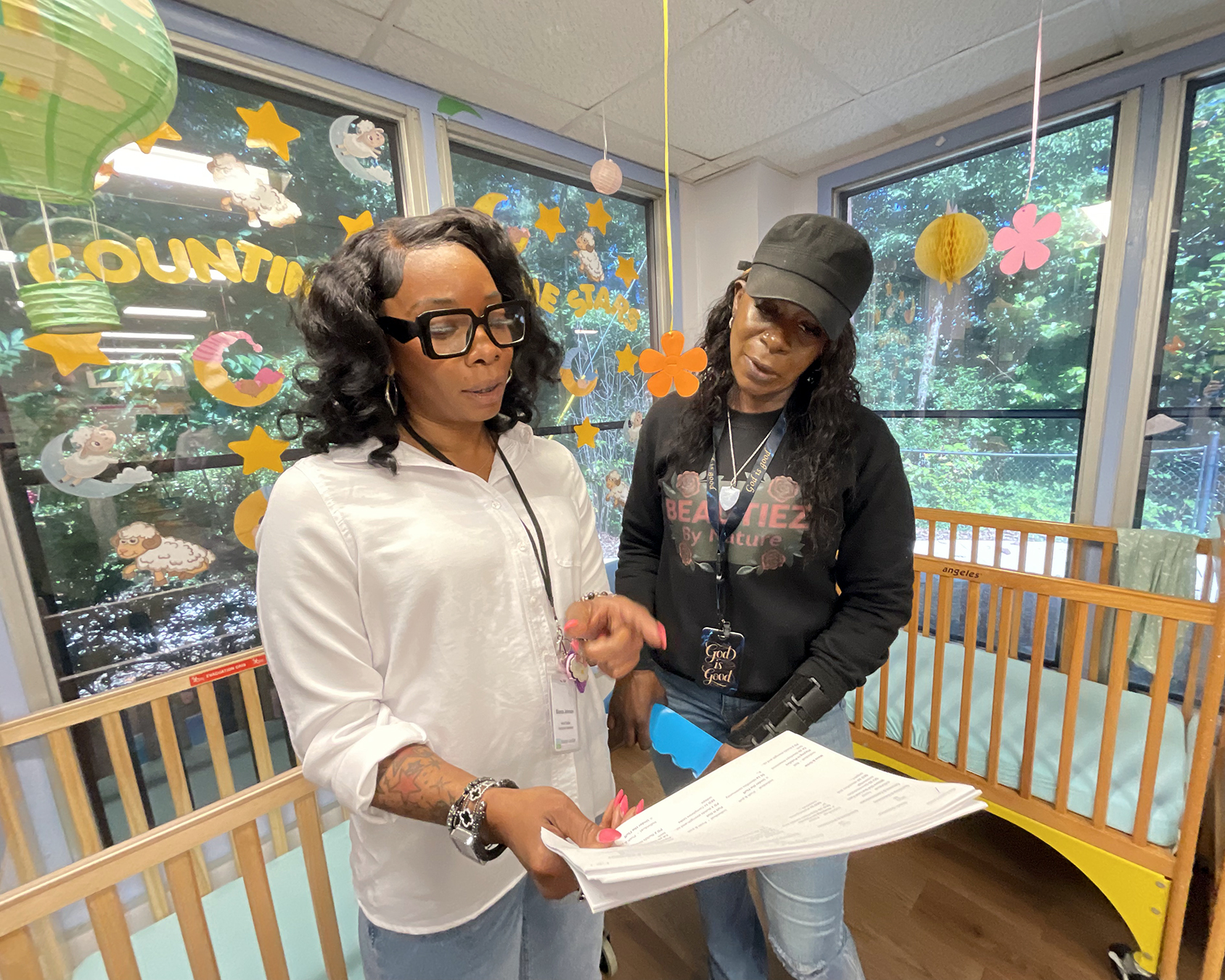
Soon after arriving at Frazer, Bianca spent time observing one of the young toddler classrooms. Rather than making immediate changes, she watched the rhythms of the room and how children and teachers moved from one part of the day to another.
“She took some time to stand back and look at the dynamics of the classroom,” Susie said.
Bianca then worked with the teaching team on transitions, including consistent language and songs that signal to the one-year-olds what is happening next. Susie has seen more structure take hold for the children and teachers.
Bianca sees trust running through those everyday routines: children trusting teachers, parents trusting teachers, teachers trusting administrators.
And with infants and toddlers, signs of learning can appear quickly.
In her first weeks at Frazer, Bianca has watched infants move from crawling to standing to walking. She listens for new words and notices when a child begins to wave or use a sign.
“You can hear learning happening,” she said.
Those changes are part of what drew her to the youngest children in the first place. When Bianca worked with older students, she often wondered what had come before. What experiences had shaped them? What had happened in those earliest years?
Working with infants and toddlers puts her closer to the beginning.
“You have the front seat to see who they are without the other voices coming in,” she said. “At that age, it’s all about what’s in their heart.”
Bianca wants families to know Frazer for the quality of its education and its teachers. She sees her role as making sure teachers have the support, coaching and ideas they need to do their best work with children.
For Bianca, some of that work comes back to something she needed herself as a child: an adult who pays attention.
So she looks for the quiet child. She gets down on their level.
And she talks to them.